 Frame Rate Files
The problem with this genre is structural and nobody talks about it honestly. A soulslike front-loads its identity: the first area teaches the systems, the third boss is usually the memorable one, and by hour twenty you are fighting larger versions of things you already understand. Difficulty rises, invention falls. Ashen Vigil is the first game in years that appears to have noticed, and its answer is simply to spend its budget later.
Its seventh boss — a two-phase encounter in a flooded reliquary where the water level responds to your positioning rather than a script — is better designed than anything in the opening twenty hours. That is a genuinely radical distribution of effort, and it is why the score above sits where it does despite a first act I found close to tedious.
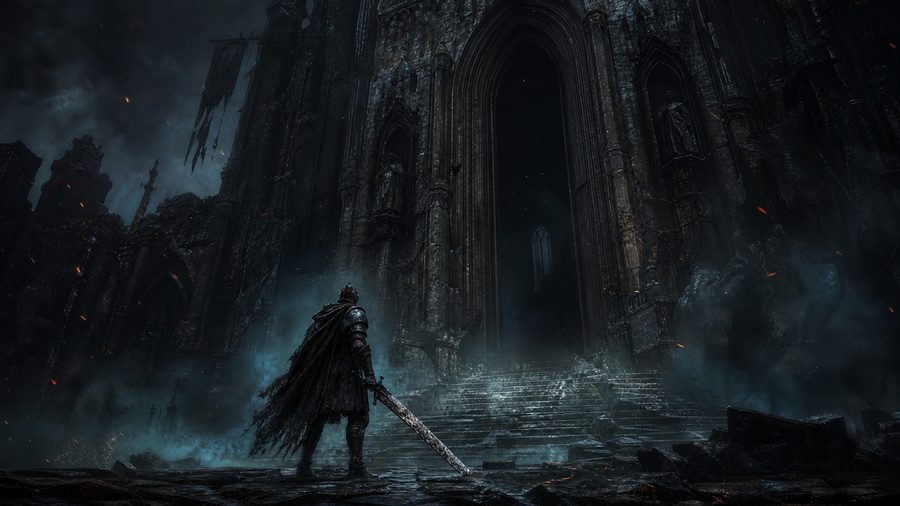
The opening you have to get through
Hours one to twelve are the most conventional thing here. You get a hub, a bonfire equivalent, a stamina bar, a parry with a nine-frame window, and three areas that could have come from any of a dozen games. The combat is tight and the animations have real weight, but nothing in this stretch is new, and if you have played four of these already you will spend the first evening waiting for the game to say something.
It says it at the tomb gate. Around hour thirteen the game introduces the vigil mechanic that gives it a name: certain enemies do not respawn at a rest point, but instead relocate, and the game tracks where they went. Clearing an area becomes semi-permanent and geographically consequential, which changes how you approach every subsequent route. It is the first moment the design shows its own personality, and it arrives about six hours later than it should.
By the final third the map is a record of your own decisions rather than a fixed obstacle course. Two players forty hours in will have meaningfully different worlds, and that is not something the genre usually offers outside of scripted branches.
Boss design, ranked by what it asks of you
Nine bosses. Four are good, two are excellent, and three are the reason to buy the game. What separates the top tier is that they test comprehension rather than execution — you can beat them at a lower level with better understanding, which is the hardest thing to build in this genre and the easiest to fake with health bars.
- The reliquary duo (boss seven). Water level responds to your position. Two attempts to understand, eleven to win, and not one felt unfair.
- The archivist (boss eight). Punishes memorised patterns by rearranging its own tells between phases. Genuinely novel.
- The vigil itself (boss nine). Uses the relocation mechanic from hour thirteen as the core of the fight. The best pay-off in the game.
- The gate warden (boss three). Conventional but well-tuned; the standard the opening act needed more of.
What the 1.2.0 patch changed
We originally scored this 8.4 on launch build 1.0.6. Patch 1.2.0 corrected hitbox inconsistencies on two bosses and reduced the hour-fourteen difficulty spike that made the mid-game feel arbitrary rather than hard. We replayed twelve hours to verify and revised the score upward. The old number remains visible in our review index, along with the date of the change.
Performance
| Configuration | Settings | Result |
|---|---|---|
| Current mid-range, 1440p | High, no upscaling | Locked 60; stable through every boss arena |
| Six-year-old build, 1080p | Medium | 55 to 60; two arenas drop to 48 with heavy particles |
| Both configurations | Any | Death-to-respawn loading averages 4.2 seconds |
That respawn figure matters more than any frame rate number in a game where you will die roughly two hundred times. Four seconds keeps the loop tense. Twelve would have cost this game a full point.
Who should play it
If you have bounced off this genre because it stops surprising you halfway through, Ashen Vigil is the specific answer to that complaint, and you should accept that its first twelve hours are the price of admission. If you are new to soulslikes, this is a reasonable entry point — the parry window is generous and the respawn loop is fast — but you will not appreciate what makes the back half remarkable, because you will not yet know how rare it is.